
Author
Dieses White Paper basiert auf Zusammenarbeit aus mehreren europäischen und nationalen Projekten zum Digitalen Produktpass (DPP), darunter CIRPASS‑2, PASSAT sowie weitere themennahe Initiativen.
Abstract
Thegoal of this document is to support technological convergence between
two data modelling frameworks, namely the AAS and the RDF frameworks,
often cited in the context of European DPP implementation. The document
explains the motivations behind this work and describes a number of ini
tiatives working towards this goal, in support of innovation. The document
ends with a number of recommendations. This document is the result of a
large-scale collaboration between 17 projects and 32 researchers.
Published
30. April 2026
Available
AAS/RDF Interoperability Approaches for DPP
Author
Chibuzor Udokwu, ABC Research – Austrian Blockchain Center
Stefan Craß, ABC Research – Austrian Blockchain Center
Abstract
Digital product passports outline information about a product’s lifecycle, circularity, and sustainability-related data. Sustainability data contains claims about carbon footprint, recycled material composition, ethical sourcing of production materials, etc. Also, upcoming regulatory directives require companies to disclose this type of information. However, current sustainability reporting practices face challenges, such as greenwashing, where companies make incorrect claims that are difficult to verify. There is also a challenge of disclosing sensitive production information when other stakeholders, such as consumers or other economic operators, wish to verify sustainability claims independently. Zero-knowledge proofs (ZKPs) provide a cryptographic system for verifying statements without revealing sensitive information. The goal of this research paper is to explore ZKP cryptography, trust models, and implementation concepts for extending DPP capability in privacy-aware reporting and verification of sustainability claims in products. To achieve this goal, first, formal representations of sustainability claims are provided. Then, a data matrix and trust model for generating proofs are developed. An interaction sequence is provided to show different components for various proof generation and verification scenarios for sustainability claims. Lastly, the paper provides a circuit template for the proof generation of an example claim and a credential structure for their input data validation. The proposed approach is assessed using a scenario-based evaluation to check the performance metrics for data credential verification and proof generation for verifying material composition in a product.
Published
10. Februar 2026
Available
Zero-Knowledge Proof Extensions for Digital Product Passports in Sustainability Claims Reporting and Verifications
Author
Dietmar Glachs, Salzburg Research Forschungsgesellschaft mbH
Jonas Wohnig, Salzburg Research Forschungsgesellschaft mbH
Felix Strohmeier, Salzburg Research Forschungsgesellschaft mbH
Abstract
This paper presents an approach to facilitating semantic interoperability in Digital Product Passports (DPPs) through the use of Semantic Integration Patterns (SIPs). In the context of Industrie 4.0 and the transition to a Circular Economy, DPPs serve as digital representations of physical products, enabling traceability, compliance, and lifecycle data sharing across diverse and decentralized supply networks. The proposed SIP framework provides reusable communication patterns for structured data exchange between heterogeneous systems, ensuring syntactic and semantic consistency. Leveraging standards such as the Asset Administration Shell (AAS) and various domain-specific ontologies, the paper details how SIPs abstract application functionality and minimize integration complexity. A real-world use case in ski equipment lifecycle monitoring illustrates the practical implementation of SIPs, showing how maintenance data can be securely and semantically shared using predefined templates and data dictionaries. The approach supports machine-readable, scalable, and policy-compliant data exchange in DPP ecosystems.
Published
2026
Available
Semantic Data Integration for Digital Product Passports
Author
Daniel Büttner, Dirk Schöttke & Stephan Schäfer | HTW Berlin
Sönke Knoch, Daniel Porta & Tim Schwartz | DFKI
Claudette Ocando Röhricht | XITASO GmbH
Aaron Zielstorff | Fraunhofer IESE
Andreas Bayha | fortiss GmbH
Abstract
The AAS is recognized as a key enabler for the digital transformation of industrial production. However, its implementation creates heterogeneous learning demands across technical, operational, and strategic roles—challenges that conventional training formats rarely address in a differentiated manner. This paper presents a pedagogically grounded framework for adaptive learning paths that integrates three design axes: (1) organizational maturity level, (2) role-specific competence requirements, and (3) established instructional models such as Kolb’s experiential learning cycle and scaffolding.
The framework is validated through a role-differentiated survey on AAS-related digital maturity in SMEs, revealing a pronounced need for low-threshold entry points and staged progression logic. Building on these findings, the paper demonstrates practical operationalization in three use cases: a hybrid demonstrator for immersive AAS training, a higher education implementation combining simulation and real-world integration, and a proof of concept for DPP integration in switchgear manufacturing. A prototype implementation in Moodle illustrates how maturity and role mapping can be translated into conditional learning path access. Results confirm the framework’s scalability and transferability, enabling targeted competence development aligned with real-world product lifecycle and digitalization processes. The approach addresses both researchers and practitioners, offering a replicable model for structuring complex Industry 4.0 competencies in industrial and educational contexts.
Published
February 3rd, 2026
Available
Springer (fee applies)
Adaptive Learning Paths for Industry 4.0 Competencies: Didactic Framework with Role- and Maturity-Based Differentiation Using the Asset Administration Shell
Author
Umutcan Serles | Onlim GmbH
Ioan Toma | Onlim GmbH
Abstract
Digital Product Passport (DPP) is an initiative of the European Union that promotes circular economy and sustainability in certain product groups. Its main principle is based on attaching certain metadata to a product about its life cycle and maintaining these metadata as long as the product circulates in some form. DPPs come with challenges for ICT as data and process models as well as architectures need to be established. There are light tower projects such as CIRPASS that explore diff erent avenues for such challenges and come up with recommendations alongside various national initiatives. In the PASSAT project, our aim is to support Austrian companies in the implementation of DPPs. We will analyze the requirements for DPP implementation and develop reference architectures, data models, and training material for Austrian companies and build on the EU-wide eff orts like CIRPASS. In ESWC, we want to especially focus on semantic data models for DPP and exchange ideas with the participants.
Published
June 6th, 2025
Available
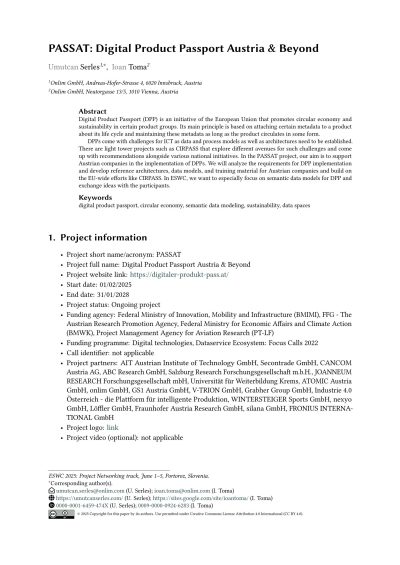
PASSAT: Digital Product Passport Austria & Beyond
Author
Büttner, Daniel | Berlin University of Applied Sciences
Schöttke, Dirk | Berlin University of Applied Sciences
Schäfer, Stephan | Berlin University of Applied Sciences
Knoch, Sönke | German Research Center for Artificial Intelligence (DFKI)
Porta, Daniel | German Research Center for Artificial Intelligence (DFKI)
Schwartz, Tim | German Research Center for Artificial Intelligence (DFKI)
Rohricht, Claudette Ocando | Xitaso GmbH
Zielstorff, Aaron orcid-logo |Fraunhofer-Institut für Experimentelles Software Engineering IESE
Bayha, Andreas | Fortiss GmbH
Abstract
The Asset Administration Shell (AAS) provides the digital foundation for interoperable systems in Industry 4.0. However, small and medium-sized enterprises (SMEs) face critical barriers in workforce qualification due to the lack of scalable training logic that aligns organizational maturity and functional roles with structured, rule-based learning paths.This paper presents a modular training framework that combines an empirically validated maturity model with role-specific learning paths. Learners are routed into one of three tracks – Initiate, Integrate, or Anchor – based on diagnostic input that reflects their organizational readiness and functional role profiles.The framework is implemented in a configurable Learning Management System (LMS) utilizing rule-based logic, including conditional access, content visibility controls, and progression triggers. Validation is grounded in a structured survey of German SMEs, which confirms heterogeneous maturity levels and training needs.The resulting system enables differentiated, scalable upskilling strategies aligned with AAS deployment, offering a practical basis for integration into industrial qualification programs and corporate training infrastructures.
Published
October 21st, 2025
Available
IEEE Xplore (fee applies)
Bridging the Qualification Gap for the Asset Administration Shell: A Modular and Role-Based Learning Framework
Author
Diogo Sasdelli | Universität für Weiterbildung Krems
Thomas J. Lampoltshammer | Universität für Weiterbildung Krems
Abstract
With the advent of the Digital Product Passport (DPP), introduced in the Ecodesign for Sustainable Products Regulation (ESPR), information concerning various aspects throughout a product’s value chain – from design to disposal – is to be made available in the future. This pursues the goal of promoting the establishment of a so-called circular economy in the European Union. The possibility of processing personal data within a DPP raises data protection issues, particularly concerning the lawfulness of storing customer data. Challenges arise especially in connection with the interpretation of the terms “explicit consent” and “customer” in Art. 10(1)(e) ESPR, as well as concerning the identification of the applicable sanctions in case of a violation of this article, in particular in view of the principle ne bis in idem. The paper at hand discusses these issues and proposes respective solutions.
Published
December 22nd, 2025
Available